Agentic Commerce: What Google's Universal Commerce Protocol means for brands
For the last two decades, online shopping has followed a familiar path.
A customer discovers a product, visits a website, browses categories, compares options, adds an item to their cart, and completes checkout.
That journey is now starting to change.
With the launch of Google's Universal Commerce Protocol (UCP) and Shopify's growing investment in agentic commerce, we are witnessing the early foundations of a new buying experience—one where customers can discover, evaluate, and purchase products without ever visiting a traditional storefront.
While widespread adoption will take time, the direction is clear.
Commerce is moving closer to where conversations happen.
And brands that prepare now will be in a stronger position as AI-powered shopping becomes increasingly mainstream.

What is Agentic Commerce?
Agentic Commerce refers to AI systems that can take action on behalf of consumers throughout the purchasing journey.
Rather than simply recommending products, AI agents can understand intent, compare options, answer questions, and ultimately facilitate transactions.
Imagine a customer asking:
"What's the best lightweight running shoe for rainy runs that can be delivered before the weekend?"
Instead of receiving a list of links, the AI could:
Understand the requirements
Compare suitable products
Verify stock availability
Apply relevant promotions
Confirm delivery timelines
Complete the purchase
All within a single conversation.
The traditional journey between discovery and checkout becomes dramatically shorter.
Introducing the Universal Commerce Protocol (UCP)
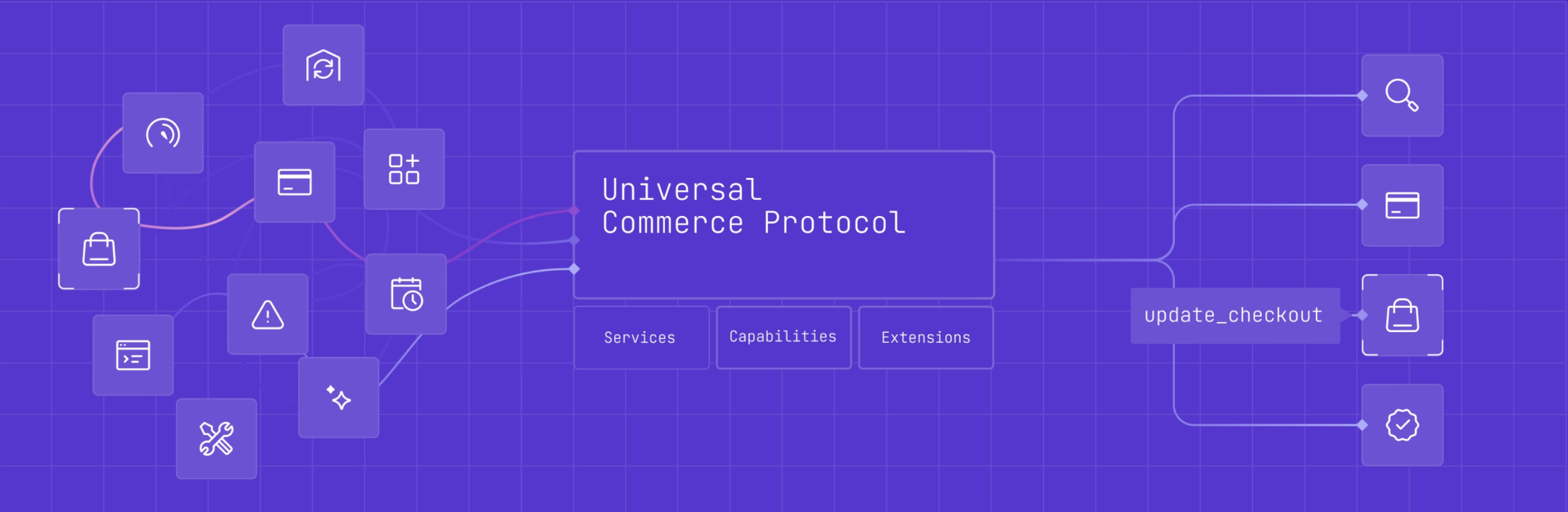
At the centre of this evolution is Google's new Universal Commerce Protocol.
Developed in collaboration with Shopify and a broader ecosystem of commerce partners, the UCP creates a standardised framework that allows AI agents to transact with retailers across different commerce platforms.
In practical terms, it acts as a universal language for commerce.
Instead of building custom integrations for every AI platform, merchants can expose product, pricing, inventory, fulfilment, and checkout capabilities through a common protocol.
The result is simple: AI experiences can become transaction-enabled.
For Shopify merchants, this capability is already beginning to surface through integrations with platforms such as Microsoft Copilot and Google's AI-powered shopping experiences.
Why This Matters
Many discussions around AI focus on content generation and automation.
Agentic Commerce is different.
It has the potential to reshape one of the most important aspects of e-commerce: how customers buy.
Historically, brands controlled every stage of the customer journey through their own storefronts.
In an AI-first world, some of those interactions may happen elsewhere.
Customers may increasingly:
Discover products within AI environments
Compare products through conversational interfaces
Receive recommendations from AI assistants
Complete purchases without visiting a website
This doesn't mean storefronts disappear, far from it. Your website remains the primary destination for brand storytelling, education, merchandising, loyalty, and customer engagement. However, it may no longer be the only place where transactions happen.
Google's broader Agentic Commerce ecosystem
The Universal Commerce Protocol is only one piece of a much larger strategy.
Alongside UCP, Google has introduced several new initiatives designed to support AI-led commerce journeys.
Business agent
Think of this as a digital sales associate that lives inside Google Search.
Customers can ask questions about products, receive personalised recommendations, and interact with a brand in a more conversational way.
Over time, these agents are expected to become increasingly sophisticated, supporting:
Product discovery
Customer education
Offer recommendations
Personalised shopping assistance
Transactional support
For brands operating in categories with complex buying decisions, this could become a powerful conversion tool.
Enhanced merchant center data
Google is expanding product data requirements beyond traditional attributes.
Future AI-powered shopping experiences will rely on richer contextual information such as:
Frequently asked questions
Product compatibility
Alternative products
Usage guidance
Accessory recommendations
The quality of your product data is becoming increasingly important.
Products that are easier for AI systems to understand will be easier for customers to discover.
Direct offers
Google is also testing AI-powered promotional experiences.
When shoppers show strong purchase intent, AI systems can surface relevant offers directly within conversational shopping journeys.
This creates new opportunities for brands to influence purchasing decisions without relying exclusively on traditional advertising formats.
The real opportunity isn't AI. It's commerce readiness.
Whenever new technology emerges, many brands immediately ask:
"What should we implement?"
The better question is:
"Are our foundations ready?"
Most retailers do not need to overhaul their commerce stack tomorrow but what they do need is stronger commerce hygiene.
The brands most likely to succeed in AI-powered commerce are not necessarily those adopting every new feature first.
They are the brands with the cleanest operations.
Four areas every brand should review
1. Product data quality
AI systems rely on structured information.
Poor product titles, inconsistent attributes, incomplete specifications, and unclear variant structures create friction.
Brands should review:
Product titles
Product descriptions
Variant naming conventions
Product attributes
Category structures
The clearer your catalogue, the easier it becomes for AI systems to recommend your products accurately.
2. Inventory and fulfilment accuracy
Nothing damages trust faster than recommending a product that cannot be delivered.
As AI shopping experiences become more transactional, inventory accuracy becomes increasingly important.
Key considerations include:
Real-time stock visibility
Accurate delivery promises
Regional fulfilment rules
Shipping restrictions
Operational excellence becomes customer experience.
3. Pricing and promotion governance
Promotions need to be understood not only by customers but also by machines.
Complex discount structures may create confusion within AI-led buying journeys.
Brands should focus on:
Clear promotional rules
Consistent pricing strategies
Transparent offer eligibility
Simplified discount structures
4. Customer policies
Returns, exchanges, subscriptions, and order changes should be easy to understand and easy to execute.
As AI agents increasingly support transactions, policies will need to be machine-readable as well as customer-friendly.
Simple policies often outperform complicated ones.

What should brands do next?
The emergence of agentic commerce does not require immediate transformation.
It does require awareness.
This is one of the most significant shifts in digital commerce since the introduction of mobile shopping.
Brands should begin by:
Educating internal teams
Reviewing product data quality
Assessing commerce operations
Strengthening fulfilment processes
Evaluating AI readiness across channels
Most importantly, they should remain focused on serving customers effectively regardless of where the transaction happens.
Final thoughts
The future of commerce is unlikely to be entirely AI-driven.
It is far more likely to be AI-assisted.
Customers will continue to visit websites, engage with brands, and seek human reassurance for important purchasing decisions.
At the same time, a growing number of shopping journeys will begin—and potentially end—inside conversational interfaces.
The launch of Google's Universal Commerce Protocol and Shopify's agentic commerce ecosystem represents an important step towards that future.
For brands, the challenge is not chasing every new feature.
It's ensuring that the operational foundations of the business are strong enough to thrive wherever customers choose to buy.
Because in an AI-first commerce landscape, great customer experiences won't start at checkout.
They'll start with the quality of the data, systems, and processes that power everything behind it.
Need help preparing for Agentic Commerce?
At Skalar, we work with ambitious brands to build scalable, future-ready commerce experiences that drive growth across every channel.
If you'd like to discuss your e-commerce strategy, AI readiness, or Shopify ecosystem, get in touch with our team today. We'd be happy to explore how we can support your next stage of growth.
